Bring in what you already have
Recordings, reports, PDFs, articles, videos, and whole collections — from the tools your team already uses.
Nothing has to be reformatted first — drop in a file or connect a source, and it joins the archive as it is.
Your recordings, documents, publications, and media become one archive: searchable by meaning, answerable across supported languages, reviewable by your team, and traceable back to the source.
Free 30-day pilot · from €69/mo
I can't speak for everyone's journey — but from our teaching I can point you to a few honest first steps, and show you where each one is taught.
The first step is rarely a leap; it's turning up with your questions intact. Faith is taught as something you grow into through regular gathering, not a test you pass on day one.1
A common starting place is a single Gospel — often Mark — a few verses at a time, asking what it shows about Jesus rather than trying to settle everything at once.2
First steps hold better in company: a first-steps group, a conversation with a pastor, a midweek table — somewhere you can return to and be known.3
I can't give a full rundown of every law and benefit here — but from the archive I can pull together practical safeguards for staying safe at home, easing loneliness, and guarding against financial abuse, and show you where each comes from.
Help is easiest to arrange early — before a fall or a crisis — while the person can still choose calmly what would make daily life safer: a cleaner, a handrail, meal delivery, a medication reminder. The aim is to keep ordinary decisions with them.1
Occasional contact isn't the same as belonging; belonging needs repetition — being expected at a regular time, and missed when you're not there. The advice is to rebuild it in places you could return to three times: a senior centre, a choir, a community café.2
The warning sign is the loss of free choice — support should grow an older person's ability to decide, not replace it. It's worth watching who holds access: the bank card and PIN, the post, the conversations with institutions.3
I can't offer a full literature review here — but from our own reports and briefs I can summarise what we've found on winter energy poverty, and link each claim to its source.
The risk concentrates in low-income households in poorly-insulated housing, where a cold snap forces a choice between heating and other essentials — and it falls hardest on older people and families with young children.1
Short-term payments ease the immediate crisis, but the durable gains in our data come from fabric measures — insulation and efficient heating — that lower the bill every winter, not just this one.2
Coverage drops off on long-term outcomes; most sources track the season they were written in, so claims about multi-year impact aren't well-supported yet.3
A folder stores files. A CMS publishes pages. A living archive connects material, meaning, language, permissions, and source, so your knowledge can be searched, asked, translated, cited, and reused.
New recordings, documents, publications, media, and notes become part of the same searchable memory.
Search finds related ideas even when the exact words differ, so nothing is lost to phrasing.
Transcripts, translations, and reviewed multilingual answers stay connected to their source.
Every answer, page, and quote can point back to the original material it came from.
Most content-rich organizations don't have a content problem — they have a retrieval problem. Here is what changes the day the archive goes live.
Keep the website you already have, or launch a public archive site from a template designed for your organization. Same archive, same permissions, same citations.
Bring in what you already have. Your material becomes transcripts, translations, tags, links, and citations so people can search it, ask questions, and publish from it.
Recordings, reports, PDFs, articles, videos, and whole collections — from the tools your team already uses.
Nothing has to be reformatted first — drop in a file or connect a source, and it joins the archive as it is.
Your material is transcribed, indexed, translated, tagged, and linked, with human review where accuracy, tone, or publication quality matters.
Every step can stay reviewable, so the archive remains accurate as it grows.
People can search directly or ask the archive a question. Results can surface across original, transcribed, and translated material, with citations attached.
One index answers both ways, with source links returned alongside the result.
Turn archive material into public pages, collections, citations, and multilingual knowledge surfaces without separating it from the source.
The same archive powers a public site, an embedded widget, or an API — wherever your audience already looks.
People get two ways into the same archive: search when they know what they need, and ask when they want the archive to explain, compare, summarize, or trace an answer back to source.
Each organization keeps its own archive private, while approved collections, sources, or public pages can appear in shared spaces when collaboration calls for it.
Each youth organization, funder, training provider, or research partner keeps its own users, permissions, languages, and source material.
Approved material can appear in a common search, youth opportunity hub, campaign archive, or public consortium site.
Each organization controls what is shared, what stays private, and what can be cited publicly.
If your mission produces knowledge faster than anyone can find it again, that backlog can become an asset: searchable, reusable, multilingual, and source-backed.
Teaching, sermons, study guides, and service recordings made searchable for members and multilingual communities.
Reports, campaigns, training material, and field evidence that stay reusable after projects end.
Papers, interviews, datasets, and editorial notes tied back to their exact source.
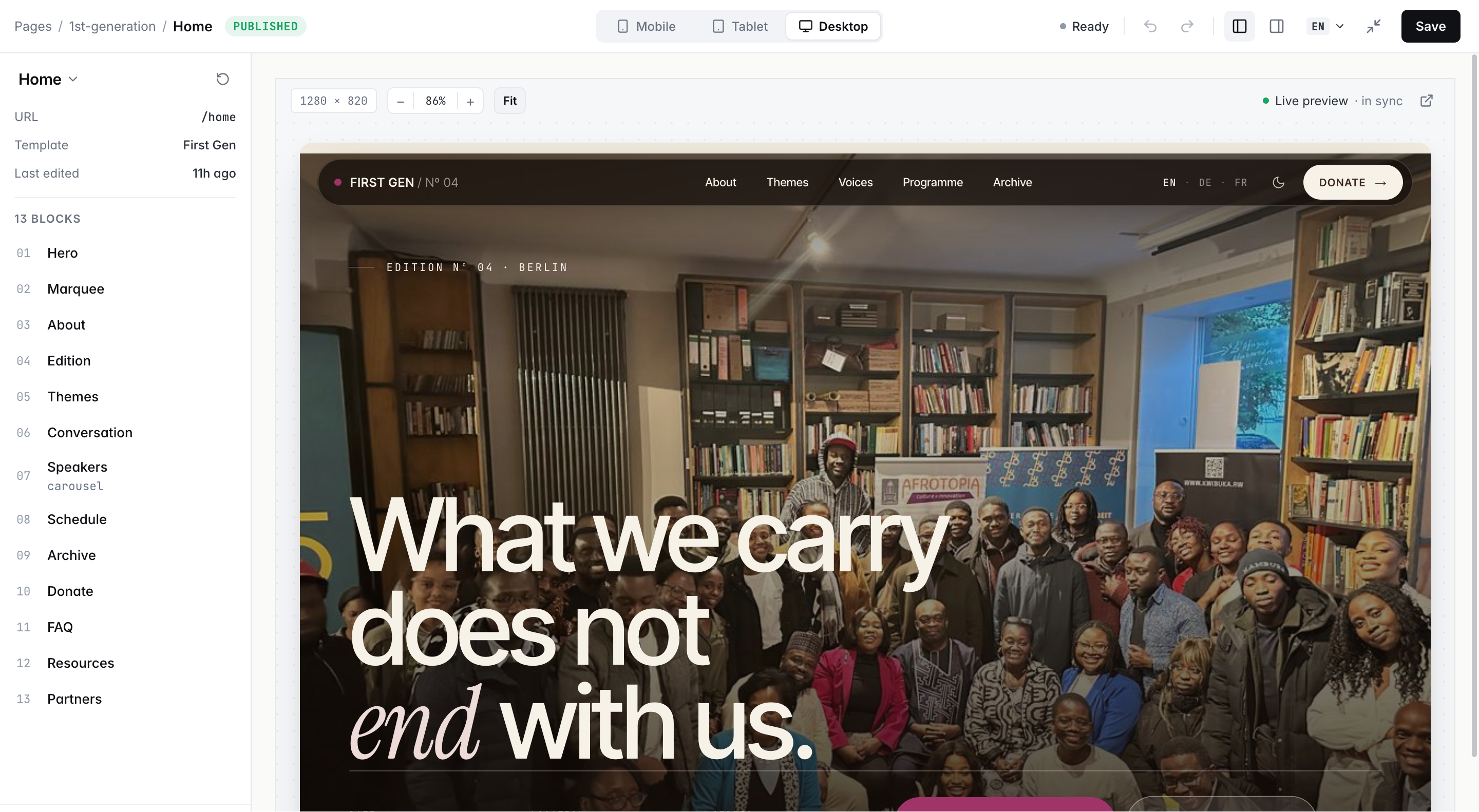
Not a separate website builder bolted on the side. Public pages come from the same archive your team uses internally, so collections, citations, translations, and updates stay connected.
The editor next to the published page. Edit a block on the left, watch the live edition render on the right across mobile, tablet, desktop, and supported languages.

Trust here is operational: visible in every answer, every permission, every review step, and every export.
Answers are generated only from your indexed material, and every claim carries a citation back to its exact source — page, paragraph, or timestamp. An answer with no supporting citation is not shown as fact.
Editors approve transcripts, translations, and public outputs before anything ships.
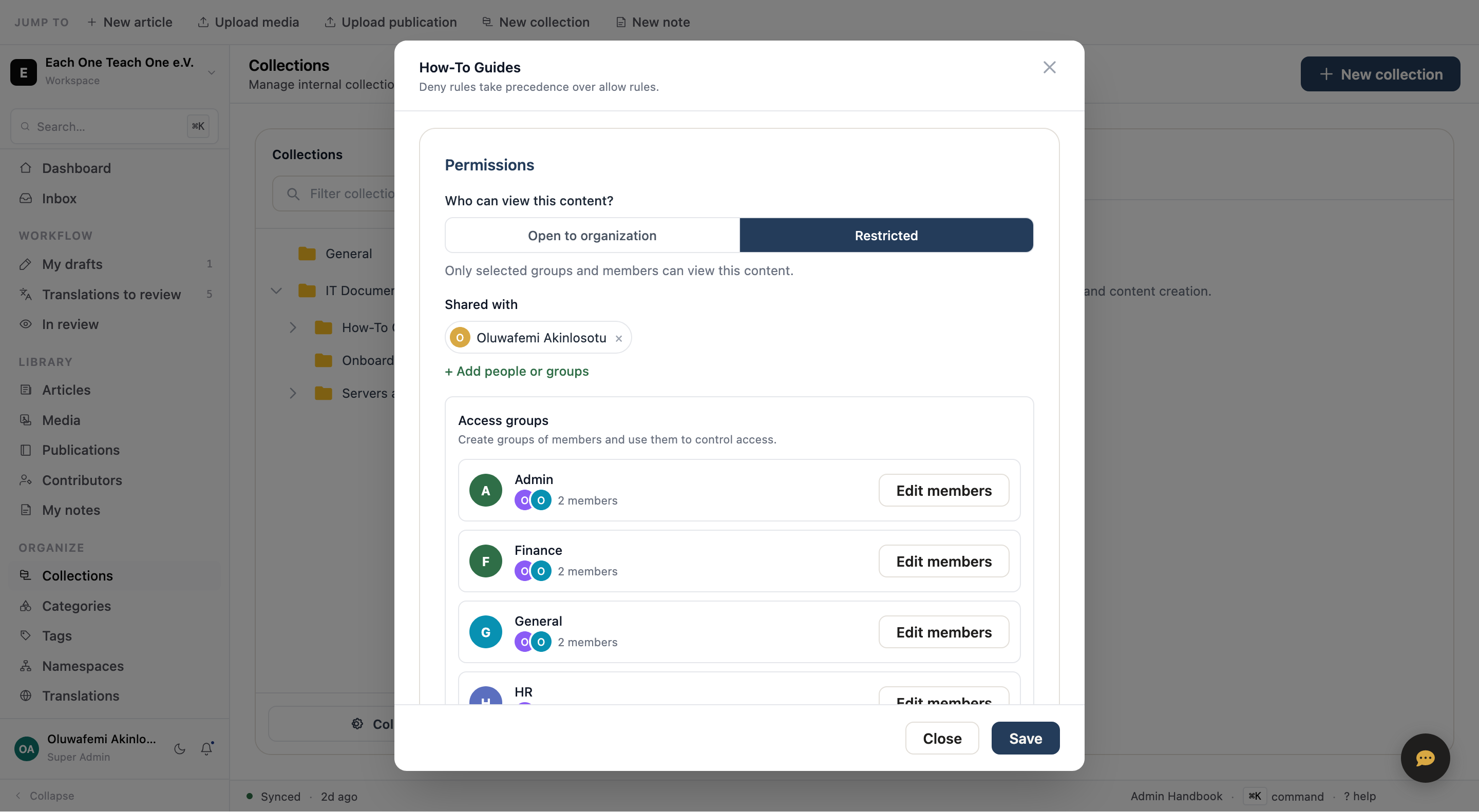
Restrict by organization, group, member, collection, or source. Deny takes precedence over allow.
EU-hosted by default, with privacy controls and traceable activity.
Cookie settings, analytics gating, and public-page controls stay intact.

Bring a real corpus: recordings, documents, publications, media, notes, or teaching material. In 30 days, your team can test a searchable, multilingual, source-backed archive with real questions.